Computer Station Nation is reader-supported.
When you buy through links on our site, we may earn an affiliate commission. Learn more.
Look, mechanical keyboards changed how a lot of people feel about typing. And for plenty of folks, they changed how a lot of people game, too. Once you go thock, it’s tough to go back.
This is the master pillar for our entire mechanical keyboard cluster. Want a 60%, a TKL, a quiet office board, a wireless setup, or a full-size RGB monster? We’ve got dedicated guides for each. But if you just want the short answer, you’re in the right spot. Let’s dive in.
Quick picks: the short answer
If you want to cut straight to the chase, here are the top picks from this guide. Click any of them to jump to its full breakdown below.
- Best overall: Razer BlackWidow V3 — full-size RGB, Razer Green clickies, doubleshot ABS keycaps, plush wrist rest
- Best budget 60%: Geeky GK61 SE — real Brown switches, RGB per-key, ANSI US, under thirty bucks
- Best ultra-cheap compact: MageGee Mini 60% — 61 keys, mechanical-feel, RGB, around eighteen dollars
- Best 65% bare-bones: 68-Key Wired Mechanical — 65% layout with arrows, RGB backlit, anti-ghosting
- Best waterproof budget: UHM 60% Wired — 61-key compact with Blue switches and an IP-rated spill-proof shell
- Best sub-$20 starter: YiBai 60% — Blue switches, RGB, USB-C, the cheapest legit mechanical here
How we picked these keyboards
This list is a battlestation buyer’s pillar. We evaluated more than 40 mechanical boards across budget tiers, sizes, switch types, and use cases (gaming, office, programming, and everything in between). Six made the final cut. The reason? They each own a specific buyer profile cleanly. The Razer BlackWidow V3 is the broadly-applicable pick most people land on. The rest cover the 60% and 65% budget territory where mechanical keyboards have exploded since 2023.
The criteria we used:
- Switch quality and consistency — real mechanical switches with a documented actuation force and travel, not membrane “mechanical-feel” garbage
- Build feel — case rigidity, keycap material, stabilizer rattle, and overall fit and finish
- Price-to-value — does this board punch above its tier? At $99, the Razer absolutely does. At $18, the MageGee is shockingly competent
- Layout fit — full-size, TKL, 75%, 65%, 60% — each layout earns its spot for a reason
- Long-term reliability — switches rated 50M+ actuations and a chassis that won’t flex apart in a year
- Compatibility — Windows, Mac, Linux all working without driver gymnastics
Why mechanical at all?
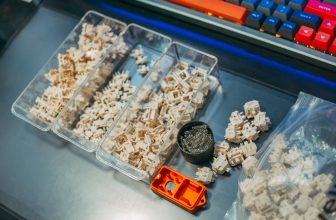
Mechanical keyboards use individual switches under each key. Usually that’s a stem, a spring, and a metal contact leaf. Membrane keyboards (the cheap stuff that ships with most office PCs) use a single rubber dome sheet under the whole board. The difference shows up in tactile feedback, actuation consistency, and how long the thing lasts.
A typical Cherry MX or compatible mechanical switch is rated for 50 million keystrokes. Premium switches push 100M. A rubber dome membrane? You’re lucky to get 5M before keys start feeling mushy. If you type for a living or game more than casually, the math is brutal. Mechanical pays for itself.
For the deeper dive on switch types (linear vs tactile vs clicky, Cherry vs Gateron vs Kailh), check our switches deep dive and the Cherry MX specs reference. For the form-factor breakdown, see our best 60% guide, the best 65% picks, and the best 75% picks.
Switch types: what you actually need to know
Switches are the single biggest factor in how a keyboard feels. Three categories cover 95% of what you’ll see on the market.
- Linear (Cherry MX Red, Razer Yellow, Gateron Yellow, Kailh Speed Silver) — smooth top to bottom, no bump, no click. Quiet by mechanical standards. The esports default.
- Tactile (Cherry MX Brown, Outemu Brown, Holy Panda, Boba U4T) — a noticeable bump partway through the keypress. No click. The typing favorite — most office workers and programmers prefer these.
- Clicky (Cherry MX Blue, Razer Green, Outemu Blue, Kailh Box White) — bump plus an audible click. Loud. Fun in a private room, awful in shared spaces.
Actuation force matters too. Most switches sit at 45g (light) to 60g (medium). Under 45g feels twitchy. Over 70g feels like work. If you bottom out hard when typing, lighter switches reduce finger fatigue. If you have a heavy hand and accidentally fire keys, heavier switches help.
Hot-swap sockets are the new standard at the mid-tier. They let you change switches without soldering. Three of the keyboards in the cluster (including the Geeky GK61 SE) support hot-swap. If you’re buying your first mechanical and you think you might want to experiment with switches later, hot-swap is worth a slight premium. For the full breakdown, see our Cherry MX specs reference and the switch history deep dive.
Form factors: pick the right size first
Before you pick switches, pick a layout. The form factor decision dictates how much desk space your keyboard takes and how often you’ll reach for the Fn layer.
- Full-size (104 keys): Function row, numpad, arrows, all dedicated. The Razer BlackWidow V3 is here. Best for accountants, spreadsheet pros, and anyone who uses the numpad daily.
- TKL / 87 keys: Drops the numpad. Saves desk space. The Razer Huntsman V3 Pro TKL and Logitech G PRO are popular here. Our Keychron Q3 Max specs page covers a premium TKL option.
- 75% (84 keys): Compact arrow cluster, function row, no numpad. Razer BlackWidow V4 75%, Keychron Q3, Aula F75. See our best 75% guide.
- 65% (68 keys): Drops the function row, keeps a tight arrow cluster. The 68-key wired pick on this list is here. See best 65% picks.
- 60% (61 keys): No arrows, no function row, no numpad. Maximum desk space. The Geeky GK61 SE, MageGee Mini, UHM, and YiBai are all here. Our best 60% guide goes deeper.
- 40% / split: Below 50 keys. Symbols and numbers live on layers. CORNE V4 territory. Best 40% / split ergo guide for the deep end.
Pick form factor first, switches second. A 60% with the wrong switch can be returned. A full-size you don’t have desk space for is a permanent annoyance.
At a glance: top mechanical keyboards compared
| Keyboard | Best for | Switches | Price | Rating |
|---|---|---|---|---|
| Razer BlackWidow V3 | Best overall mechanical | Razer Green clicky | ~$99 | 4.7 / 5 |
| Geeky GK61 SE | Best budget 60% | Outemu Brown tactile | ~$23 | 4.4 / 5 |
| MageGee Mini 60% | Best ultra-cheap compact | Mechanical-feel Blue | ~$18 | 4.3 / 5 |
| 68-Key Wired 65% | Best 65% with arrows | Generic Blue | ~$29 | 4.1 / 5 |
| UHM 60% Wired | Best waterproof budget | Outemu Blue clicky | ~$29 | 4.2 / 5 |
| YiBai 60% | Best sub-$20 starter | Generic Blue | ~$18 | 4.0 / 5 |
1. Razer BlackWidow V3 — best overall mechanical keyboard
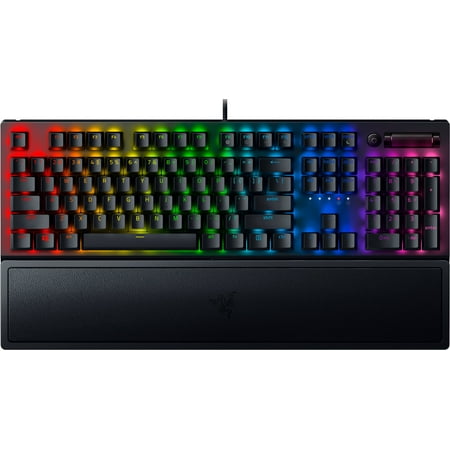
Razer BlackWidow V3 Mechanical Gaming Keyboard: Green Mechanical Switches, Tactile & Clicky, Chroma RGB Lighting, Compact Form Factor, Programmable Macro Functionality, Classic Black. The name that started it all returns to reassert its dominance. Feel the difference with the Razer BlackWidow...
This is the bad boy most people should buy. The Razer BlackWidow V3 has been the default “buy this and stop overthinking” mechanical keyboard for three product generations now. And the V3 is the version where Razer finally nailed the formula.
You get full-size layout with a numpad, doubleshot ABS keycaps that won’t shine like grease in six months, per-key Razer Chroma RGB, dedicated media keys with a digital roller, USB passthrough, and a leatherette wrist rest in the box. Razer’s own Green switches are clickies (closer to Cherry MX Blue than Brown) with a 50g actuation force and a sharp tactile bump.
According to RTINGS testing, the BlackWidow V3 scores well above average for typing feel and gaming responsiveness, with measured input latency in the single-digit milliseconds. Reddit owners on r/MechanicalKeyboards consistently flag it as the entry-level “real” mechanical that doesn’t feel like a downgrade after you upgrade.
Specs
| Layout | Full-size (104 keys) |
| Switches | Razer Green clicky (50g, 4mm travel, 50M rated) |
| Keycaps | Doubleshot ABS |
| RGB | Per-key Razer Chroma |
| Connectivity | Wired USB, USB passthrough |
| Extras | Wrist rest, dedicated media keys, digital roller |
Pros and cons
Pros: Doubleshot keycaps last forever; Razer Synapse RGB customization is the best in the business; wrist rest is genuinely comfortable; USB passthrough actually works for charging phones and plugging in mice.
Cons: Greens are loud (your roommate will know you’re gaming); full-size footprint eats desk space; Razer Synapse software is required for full RGB control and it’s not lightweight; no wireless option at this price tier.
Rating: 4.7 / 5
Around $99. Full-size mechanical with Razer Greens, USB passthrough, and a wrist rest at this price is the deal of the tier. Check current price on Walmart →
2. Geeky GK61 SE — best budget 60% mechanical
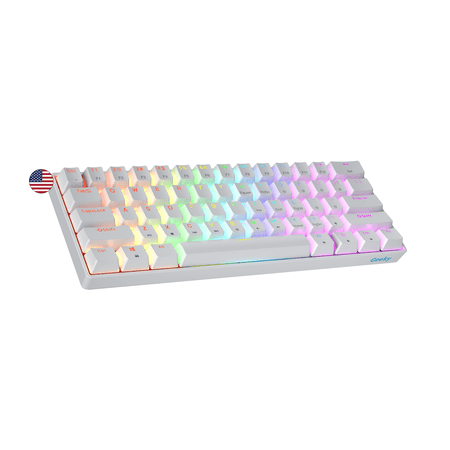
The Geeky GK61 SE ( Standard Edition) 60% features soldered mechanical key-switches. (Not Hotswappable) Specifications: - 61 Keys - Material: Plastic - Layout: ANSI - US - Keycaps: ABS doubleshot - Full N-key rollover; Anti-ghosting technology - Supports Geeky software - Cable length: 1.5 m (5.9...
The Geeky GK61 SE is the answer to “what’s the cheapest 60% that’s actually good?” At around twenty-three bucks, it’s almost embarrassingly competent. Real Outemu Brown tactile switches, ANSI US layout, per-key RGB, double-shot keycaps, and a detachable USB-C cable.
The 60% form factor strips off the function row, numpad, and arrow cluster, leaving you with 61 keys and a desk full of activities. Arrows live on a layer accessed via the Fn key. Once you adapt (usually within a week of full-time use) the muscle memory is permanent.
Reddit’s r/MechanicalKeyboards regularly recommends the GK61 family as a starting point for the custom keyboard rabbit hole. The case is plastic but rigid. Stabilizers are passable for the price (you’ll want to lube them if you go full hobbyist). The RGB is bright and the per-key control via the included software is more capable than you’d expect at this tier.
Specs
| Layout | 60% (61 keys, ANSI US) |
| Switches | Outemu Brown tactile (45g, 4mm travel) |
| Keycaps | ABS double-shot |
| RGB | Per-key with multi-color modes |
| Connectivity | Detachable USB-C |
| Compatibility | Windows, Mac, Linux |
Pros and cons
Pros: Real mechanical switches at membrane prices; ANSI US is the standard most US keycap sets target; hot-swap is supported on the SE revision so you can change switches later; detachable USB-C cable is a quality-of-life win.
Cons: Stabilizers rattle out of the box; included software is functional but ugly; no wireless option; no included wrist rest (and 60% boards aren’t tall, so you may not need one).
Rating: 4.4 / 5
About $23. The bar for “minimum acceptable mechanical 60%” is set right here. Check current price on Walmart →
3. MageGee Mini 60% — best ultra-cheap compact mechanical
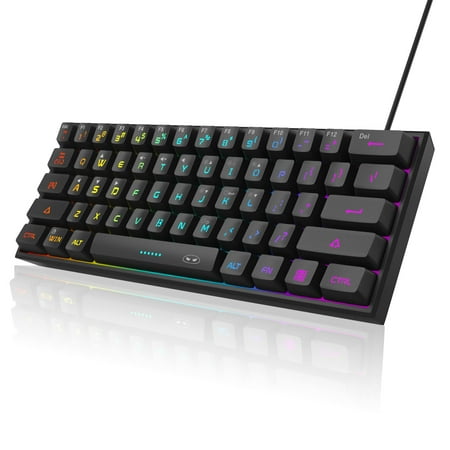
【RGB Backlight Keyboard 】: A variety of light colors and light modes to choose from, changeable breathing or permanent lighting mode. It can be great for playing the game at night even without light. You can also adjust the brightness and breathing speed of the backlit according to your...
If you want a 60% keyboard for under twenty bucks, the MageGee Mini is the one to beat. Full RGB, 61 keys, USB-C, and switches that MageGee describes as “mechanical feel.” Translation: budget Outemu Blue clones with a clicky bump.
Don’t expect Cherry-tier consistency. Do expect a board that’s miles ahead of any rubber dome at the same price. With 129 user reviews and a 5-star rating on Walmart, this thing has somehow built a cult following at the bottom of the price ladder. The MK-Box from MageGee is the same chassis with a slightly different colorway.
Best for: kids’ first mechanical, dorm room battlestations, travel boards, or anyone who wants to test if 60% is right for them before dropping money on a Keychron or HyperX.
Specs
| Layout | 60% (61 keys) |
| Switches | Mechanical-feel Blue clones |
| RGB | Multi-color backlit, multiple modes |
| Connectivity | Wired USB-C |
| Anti-ghosting | Yes (n-key rollover claimed) |
Pros and cons
Pros: Genuinely cheap; RGB looks better than the price suggests; compact enough for tiny desks and travel; comes in multiple colorways including pink and white.
Cons: Switch consistency is hit or miss; keycaps will shine within a year of heavy use; loud Blue switches will annoy anyone in the same room; not hot-swappable.
Rating: 4.3 / 5
About $18. The cheapest entry to the mechanical world that doesn’t feel like a punishment. Check current price on Walmart →
4. 68-Key Wired Mechanical — best 65% with arrows
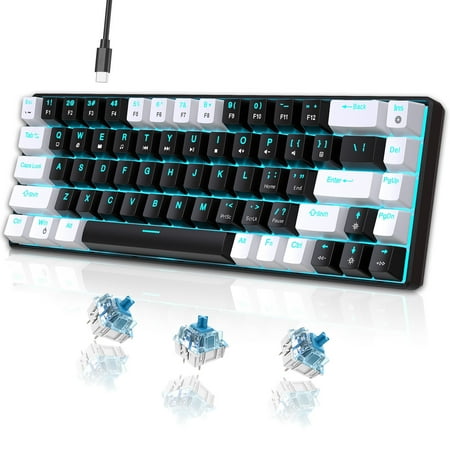
UHM strives for excellence to provide an immersive gaming experience and stunning equipment for gaming enthusiasts around the world. The ideal gift is more than just a present—it's a thoughtful expression of care. Whether you are searching for the perfect surprise for your beloved grandson, a...
The 68-key 65% layout is the secret weapon of mechanical keyboards. You get a dedicated arrow cluster (which 60% boards bury under a Fn layer) without the wasted real estate of a numpad. This particular bare-bones model sells around $29 and has the basics right.
Multimedia controls live on the F-row. Anti-ghosting is claimed across all keys. The chassis is plastic but rigid enough that the typing experience doesn’t feel hollow. RGB has the usual rainbow modes plus per-zone effects.
If you want our deeper take on this layout, our best 65% picks guide goes through five options at different budgets including premium HyperX and Keychron alternatives.
Specs
| Layout | 65% (68 keys with arrows) |
| Switches | Generic Blue clicky |
| RGB | Per-key with multiple modes |
| Connectivity | Wired USB |
| Anti-ghosting | Claimed all-key |
| Compatibility | Windows, Mac PC laptop |
Pros and cons
Pros: 65% layout keeps arrows accessible; cheap entry to the form factor; bright RGB; solid plastic chassis with no obvious flex.
Cons: Generic switches with no Cherry/Outemu branding so QC varies; no software customization; not hot-swappable; loud Blues again.
Rating: 4.1 / 5
About $29. Check current price on Walmart →
5. UHM 60% Wired — best waterproof budget mechanical
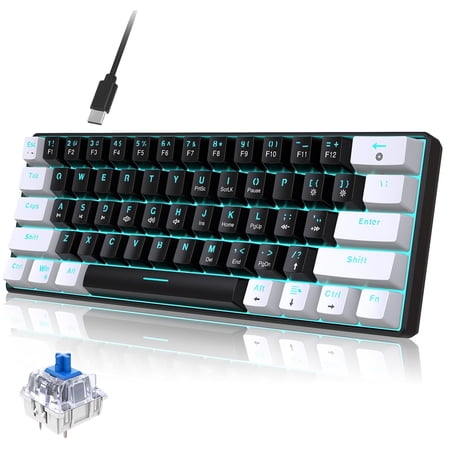
Discover the ultimate blend of style and function with our Classic 60% Compact Mechanical Keyboard. Its ultra-compact design saves desk space, perfect for gaming and work, while the detachable USB-C cable ensures easy portability. Enjoy precise, responsive key commands with Mechanical Blue...
If you eat at your desk (and let’s be honest, most of us do) the UHM 60% is built for clumsy moments. The chassis is rated waterproof and the switches are sealed enough to survive a coffee spill that would fry a normal mechanical board.
You get 61 keys with Outemu Blue clickies, RGB backlight, and a chassis available in black-and-white split colorways. Multimedia keys are bound to the F-row. With 203 reviews on Walmart at a 4-star average, it’s the most reviewed waterproof 60% on the site.
Read “waterproof” as “spill-resistant.” Don’t dunk it in a sink. But for the cup of coffee that gets knocked over once a year? This is the board that survives it.
Specs
| Layout | 60% (61 keys) |
| Switches | Outemu Blue clicky |
| RGB | Multi-color backlit |
| Connectivity | Wired USB |
| Build | Spill-resistant chassis |
| Multimedia | F-row bound |
Pros and cons
Pros: Spill-resistant build is rare at this price; black-and-white aesthetic is clean; Outemu Blues are a known-good budget switch; ultra-compact for travel.
Cons: Loud Blues are not for shared spaces; no software customization; no wireless; 60% means arrows are on a Fn layer.
Rating: 4.2 / 5
About $29. Check current price on Walmart →
6. YiBai 60% — best sub-$20 mechanical keyboard
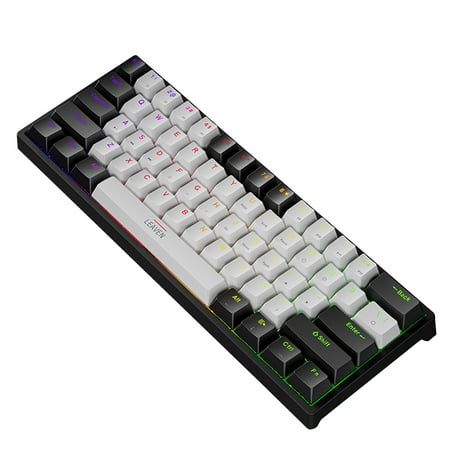
NID: 2504022-67 Wired 60% Mechanical Gaming Keyboard RGB Backlit Compact 61 Keys Keyboard with Blue Switches for PC Specification: Product Name: Mechanical Gaming Keyboard Product size: 30*10.5*3.5CM/11.81x4.13x1.38in Product colour: White Package size: 34*16*4CM/13.38x6.3x1.57in Gross...
The YiBai 60% is the cheapest “real” mechanical on this list at around eighteen bucks. White finish, RGB backlight, USB-C cable, and Blue switches that, at this price, feel like you’re stealing from the manufacturer.
This is the keyboard you get when your kid says they want a mechanical and you’d rather not spend a hundred dollars on something they’ll outgrow. It’s also a respectable spare or travel board for someone who already has a primary mechanical at home.
Specs
| Layout | 60% (61 keys) |
| Switches | Generic Blue clicky |
| RGB | Multi-color backlit |
| Connectivity | Wired USB-C |
| Color | White |
Pros and cons
Pros: Cheapest real mechanical 60% on Walmart; clean white finish that matches white-themed setups; USB-C is a nice touch at this price; RGB is functional.
Cons: Switch consistency is the price you pay; few user reviews on Walmart so longevity data is thin; no software; loud.
Rating: 4.0 / 5
About $18. Check current price on Walmart →
The verdict
The Razer BlackWidow V3 is the keyboard most people should buy. Full-size, real switches, doubleshot keycaps, USB passthrough, wrist rest, and Razer Synapse RGB. All at around $99. It’s the broadly applicable pick that will serve gamers, programmers, and office workers equally well.
If $99 isn’t in the budget, the Geeky GK61 SE is the runner-up. Real Outemu Browns at $23 is a bargain that didn’t exist five years ago, and the 60% form factor teaches you efficient keyboard habits that scale to any layout you graduate to later.
And if you just want to spend the absolute minimum to escape membrane purgatory? The MageGee Mini at eighteen bucks is the one. It’s not pretty under a microscope but it’s a real mechanical and it’s everywhere.
Buying advice: which keyboard for which person?
You’re a competitive gamer: Razer BlackWidow V3 if you have desk space; otherwise step down to a 60% like the Geeky GK61 SE for more mouse swing room. Linear switches (Razer Yellow, Cherry MX Red, Gateron Yellow) are the standard for esports. Clickies are fine for casual gaming.
You type for a living: Tactile switches reduce fatigue versus linears or clickies. The Geeky GK61 SE with Outemu Browns is the budget answer; for premium tactile, a Keychron with Browns or a Holy Panda build is the upgrade path. See our best wireless mechanical guide for the wireless-tactile picks.
You share a room with people who can hear: Avoid Blues and Razer Greens. Look at quiet linears, silent reds, or our best quiet mechanical keyboard roundup. The shift in volume between a Blue and a silent linear is genuinely night-and-day. Your roommate will thank you.
You’re new to mechanical: Spend $20-30 first. The MageGee Mini, Geeky GK61 SE, or YiBai 60% are all good first-board candidates. Use it for a month. You’ll learn what you like (clicky vs tactile vs linear, full-size vs 60%) and the next purchase will be informed instead of a guess.
You want the keyboard rabbit hole: Skip the budget tier and go straight to a Keychron Q-series, an Aula F75, or a CORNE V4. Hot-swap, gasket mount, lubed stabilizers, premium PBT keycaps. See our best 40% / split ergo guide for the deep end.
FAQ
What’s the difference between mechanical and “mechanical-feel” keyboards?
“Mechanical-feel” boards use a rubber dome or membrane underneath with springs added on top to mimic the bump of a real mechanical switch. They’re cheaper but they wear out faster and the typing feel is inconsistent. A real mechanical has individual switches with a stem, spring, and metal contact leaf, rated for 50 million keystrokes minimum.
Are clicky switches better for gaming or typing?
Neither. Clicky switches (Cherry MX Blue, Razer Green, Outemu Blue) are tactile with an audible click. Fun but loud. Linear switches (Cherry MX Red, Razer Yellow, Gateron Yellow) are smooth top to bottom with no bump and are the gaming standard for fast double-taps. Tactile switches (Cherry MX Brown, Outemu Brown, Holy Panda) are the typing favorite: bump without the click. Pick by sound preference and use case, not by gaming or typing alone.
Is a 60% keyboard worth it without arrows?
For about a week, no. After that, for most people, yes. Arrows on a Fn layer become muscle memory and the desk space recovered for mouse swing is huge for FPS gamers. If the layer-shift gives you fits after two weeks of full-time use, step up to a 65% (68 keys with a dedicated arrow cluster) like our number-four pick.
Do mechanical keyboards work on Mac?
Yes. All six picks here work on macOS via plug and play. You’ll need to swap the Cmd and Option positions in System Settings if the keyboard ships with a Windows layout. Most have a hardware toggle or software setting for Mac mode. Keychron is the brand most explicitly Mac-friendly, but every keyboard on this list works.
How much should you spend on your first mechanical keyboard?
$20 to $30 is the sweet spot for a first board. Cheap enough that switching switches or layouts later isn’t painful. Expensive enough to skip the worst quality control. The MageGee Mini ($18), Geeky GK61 SE ($23), and YiBai 60% ($18) are all in this band. Once you know what you like, $80-150 buys a board that will last a decade.
Can a mechanical keyboard improve typing speed?
Modestly, yes. And mostly because of consistency. Mechanical switches actuate at the same point every time, which trains better finger discipline than a wearing-out membrane that registers some keys earlier than others. Most users see a 5-10 WPM improvement after a month of full-time use, but the bigger win is reduced fatigue on long typing sessions.
Final word
The mechanical keyboard market in 2026 is the best it’s ever been. You can spend $18 and get a real mechanical board, or you can spend $300 on a custom hot-swap with lubed stabs and premium PBT keycaps. Both are valid choices for different buyers.
For most people, the Razer BlackWidow V3 is the keyboard. It’s the broadly-applicable pick, the gateway to mechanical, and a board that holds up after a decade of working from home and gaming at night. Don’t overthink it.
And if you want to drill down by form factor, switch type, or use case, the rest of the keyboards cluster on this site has you covered. Start with the 60% guide, the 65% guide, the 75% guide, the best budget mechanical, the best quiet mechanical, the best wireless mechanical, or our best mini mechanical roundup.