Computer Station Nation is reader-supported.
When you buy through links on our site, we may earn an affiliate commission. Learn more.
Standard gaming chairs are built for a 5’10”, 180-pound body. If that’s not you, you already know the problem. The seat cuts into your thighs. The backrest lumbar pad lands somewhere around your shoulder blades. The armrests are too narrow to rest both arms without feeling like you’re in a straitjacket. And the weight rating says 250 lbs, but anyone who’s bought furniture knows that number is a best-case scenario — not a daily-use promise.
Big and tall gamers need chairs engineered differently from the ground up. Wider seats. Higher backrests. Beefier frames. Taller gas cylinders. The spec differences are real and they matter. This guide breaks down exactly what to look for so you stop wasting money on chairs that fail in six months or leave you with back pain after a three-hour session.
For this guide, “big and tall” means anyone over 6’1″ or over 220 lbs — ideally chairs that can handle both. We’re focused on options under $200 because that’s where most buyers are shopping, and there are actually solid picks in that range if you know what specs to prioritize.
Table of Contents
- What to Look For in a Big and Tall Gaming Chair
- Key Specs at a Glance
- Who This Is For
- Top Picks
- Red Flags to Avoid
- FAQ
What to Look For in a Big and Tall Gaming Chair
Weight capacity — and why 250 lbs is not enough
Most gaming chairs list a 250 lb weight capacity. Sounds fine on paper. The issue is that furniture ratings are typically tested at static load, not dynamic use. Every time you lean back, shift your weight, or lean forward to grab something, you’re applying force well beyond your body weight. A 220-lb person sitting casually in a 250-lb-rated chair is already operating at the edge of the design envelope.
For anyone over 200 lbs, look for chairs rated at 300 lbs minimum. For 250+ lb buyers, target 400 lbs. That buffer matters for long-term frame and cylinder life. A chair that fails at 18 months isn’t a deal — it’s a liability.
Seat width and depth — hip room and thigh support
Standard gaming chair seats run about 19–20 inches wide. For wider hips or a larger build, that’s tight. You want at least 21 inches of seat width, ideally 22–23 inches. Narrow seats force your thighs against the side bolsters constantly, which cuts off circulation and gets painful fast.
Seat depth matters for taller people. A shallow seat (under 19 inches front-to-back) leaves taller thighs hanging without support. Look for 20–22 inches of seat depth. The rule of thumb: when sitting upright, the front edge of the seat should hit roughly 2–3 inches behind the back of your knees, not before it.
Seat height range — taller users need more range
A standard gaming chair adjusts from about 17 to 21 inches from floor to seat. For someone 6’2″ or taller, that top end often isn’t enough. You end up with your knees above your hips, which wrecks your posture and puts pressure on your lower back.
Taller buyers should look for seats that adjust up to at least 22–23 inches high. Some chairs marketed as big and tall top out at 21.5 inches, which barely clears the bar. Check the spec sheet before you buy — not all “big and tall” labels deliver on height range.
Armrest reach and width
Armrests on budget gaming chairs are almost universally too narrow and too close together. For a wider build, armrests that don’t spread out enough force your arms in toward your body, which loads your shoulders and upper traps over long sessions.
Look for 4D armrests (adjustable in four directions: up/down, forward/back, in/out, and rotation) or at minimum armrests with inward/outward adjustment. The ability to move them out even 1–2 inches makes a real difference in shoulder comfort. Fixed armrests are a red flag on any chair aimed at larger buyers.
Backrest height — lumbar placement on a taller torso
This is the one most people overlook. On a standard gaming chair, the lumbar support pillow sits at roughly 8–10 inches from the seat. On a 5’10” person that lines up perfectly with the lower back. On a 6’3″ person, it’s hitting your mid-back — which does nothing for lumbar support and actually creates a pressure point where you don’t need one.
For taller users, look for chairs with a backrest height of at least 33–35 inches. Taller backrests also provide actual head and neck support instead of a headrest pillow that’s too low to reach your head when you lean back.
Frame and base construction
Budget gaming chairs use thin stamped steel frames that flex under load. For heavier buyers, frame flex translates directly into sway, noise, and eventual failure. A reinforced steel frame — typically 12-gauge or heavier — holds its shape under sustained load and doesn’t develop a wobble after six months.
The base matters too. A five-star nylon base rated for 300+ lbs will crack at the wheel junction over time. Look for metal or aluminum bases on chairs intended for heavier use. The gas cylinder (piston) should be Class 4 — that’s the standard for commercial/heavy-duty seating and handles sustained daily weight better than the Class 3 cylinders found on most budget chairs.
Key specs at a glance
Here’s how standard gaming chairs compare to what you actually want for a big and tall setup:
| Spec | Standard Gaming Chair | Big & Tall Gaming Chair |
|---|---|---|
| Weight capacity | 250 lbs | 300–400 lbs |
| Seat width | 19–20 in | 21–23 in |
| Seat depth | 17–19 in | 20–22 in |
| Max seat height | 20–21 in | 22–23 in |
| Backrest height | 28–30 in | 33–35 in |
| Armrests | Fixed or 2D | 4D preferred |
| Gas cylinder class | Class 3 | Class 4 |
| Base material | Nylon | Metal or reinforced nylon |
Who this is for
Taller frame, normal weight (6’2″–6’6″, under 220 lbs)
Your main priority is backrest height and seat height range. You’re probably not stressing the weight capacity, but the lumbar on a standard chair is going to land wrong. Focus on chairs with a backrest of 33 inches or taller and a seat height that gets to 22+ inches. A taller headrest is a bonus — most chairs in this category leave taller users craning forward because the headrest doesn’t actually reach.
Larger build, shorter stature (under 6′, 250–350 lbs)
Weight capacity and seat width are your focus. You need a chair rated for at least 350 lbs with a seat width of 21+ inches. Seat height matters less here — standard range usually works fine. The frame and base quality matter a lot for longevity. A chair that works fine at purchase but starts squeaking and swaying at month eight is a chair that failed early.
Both — tall AND heavy (6’2″+ and 250+ lbs)
This is the hardest buyer to fit in the under-$200 range. You need everything: high weight capacity, wide seat, tall backrest, extended height range. The GTPLAYER Big and Tall chair in the picks below is the one option in this range that addresses all of it. Expect to spend $150+ if you’re in this category — chairs under $100 that claim to fit both criteria usually don’t hold up.
Top picks
These are the four chairs worth considering in the under-$200 range for big and tall buyers. Spec-verified, price-checked, and sorted by use case.
Best overall big and tall: GTPLAYER Big and Tall Ergonomic High Back Chair
The GTPLAYER Big and Tall Ergonomic High Back Breathable Fabric Chair is the most complete option in this price range — breathable fabric instead of vinyl, a legitimately tall backrest, and a 400 lb weight capacity that isn’t a stretch claim.
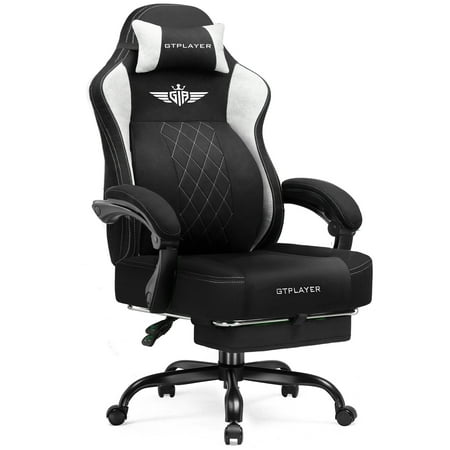
The GTPLAYER Big and Tall Gaming Chair is built for lasting comfort and support. Upholstered in breathable fabric, it keeps you cool while strong lumbar support encourages healthy posture during long hours of gaming or work. The ergonomic high-back design enhances full-body support, while the...
Best value big and tall: JONPONY Big and Tall Gaming Chair with Footrest
The JONPONY Big and Tall Gaming Chair with Computer Chair and Footrest hits the sweet spot for buyers who want the big-and-tall spec list without pushing past $110 — solid weight capacity, a retractable footrest, and adjustable lumbar support.
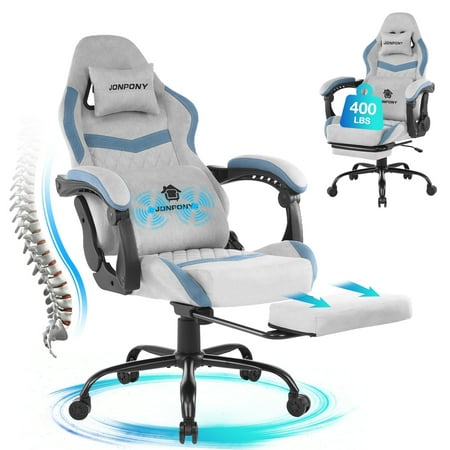
The JONPONY gaming chair is ideal for work, study, and gaming. It features an adjustable headrest and a massage lumbar pillow with pressure points, providing cervical and lumbar support. The racing-style angle adjuster allows reclining and rocking motions. High-density sponge cushions ensure...
Best with footrest under $110: Bossin Gaming Chair with Footrest
The Bossin Gaming Chair with Footrest brings a full massage function and retractable footrest at a hard-to-beat price — a good pick if the footrest and massage feature are on your must-have list.
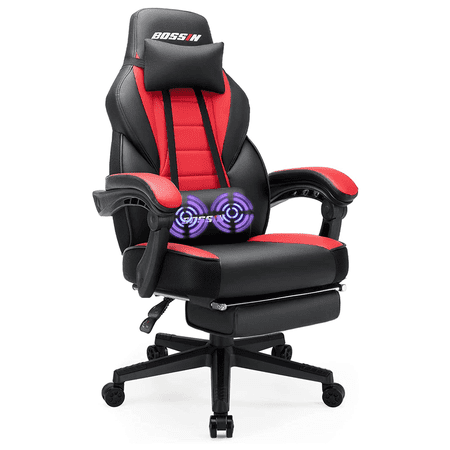
BOSSIN Gaming Chair extends the length of the backrest to support you shoulders and head. Felt relax at working period and exciting gaming sessions. And that backrest allow 90 to 155 degree movement or lying down like a bed. for taking a quick nap.Our gaming chairs not only have a cool style, a...
Best budget big and tall: JONPONY Ergonomic Big and Tall Gaming Chair
The JONPONY Big and Tall Gaming Chair with Ergonomic Design is the entry point for buyers who need big-and-tall dimensions without spending over $90 — stripped down but built on the right frame specs.
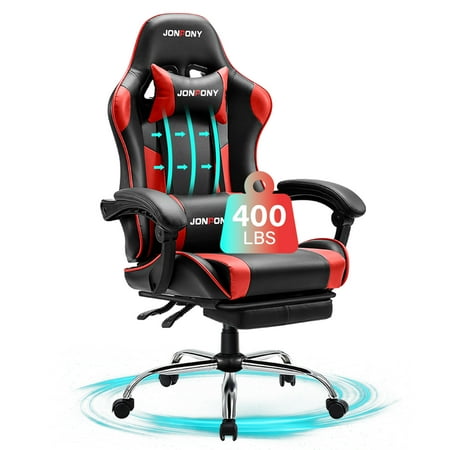
The JONPONY gaming chair is ideal for work, study, and gaming. It features an adjustable headrest and lumbar pillow for cervical and lumbar support. The racing-style angle adjuster allows reclining and rocking. High-density sponge cushions ensure all-day comfort. The ergonomic footrest...
Red flags to avoid
- Weight capacity listed as exactly 250 lbs. That’s the default spec for a standard adult chair. If it’s 250 and nothing else, it’s not a big and tall chair — it just has a tall backrest for aesthetics.
- No seat width measurement listed. If the product page shows backrest height and max load but skips seat width, that’s not an accident. It’s usually because the seat is 19 inches and they know it.
- Nylon 5-star base on a 300+ lb capacity chair. The two specs don’t match up. A chair rated for 300 lbs that ships with a standard nylon base will develop base cracks within a year of heavy use.
- “Big and tall” in the title but backrest under 31 inches. A 31-inch backrest doesn’t change the lumbar position or headrest height enough to actually accommodate a 6’2″+ user. Taller label, standard chair.
- Fixed armrests. Non-adjustable armrests on a chair aimed at bigger builds is a dealbreaker. You can’t position them to fit a wider shoulder span, and they’ll either be in the way or too far in to be useful.
FAQ
What weight capacity should I look for if I weigh 275 lbs?
Look for a chair rated at 350–400 lbs minimum. Dynamic load (leaning, shifting, reclining) can spike well above your body weight, so a 300 lb rating at 275 lbs body weight leaves almost no margin. A 400 lb rated chair gives you real headroom for long-term durability.
Is a gaming chair or an office chair better for big and tall users?
Depends on what you need. Gaming chairs tend to have taller backrests and headrests — better for reclined gaming. Office chairs in the big and tall category often have better seat width and lumbar adjustment — better for upright work posture. If you’re mixing gaming and work at the same desk, an ergonomic big and tall office chair often serves both better than a gaming-specific model.
Do I need a Class 4 gas cylinder?
For buyers over 220 lbs, yes — it’s worth confirming. Class 4 cylinders handle higher sustained loads and typically have longer rated life cycles than the Class 3 cylinders that ship with most budget gaming chairs. If the product page doesn’t specify cylinder class, that’s usually a sign it’s a Class 3.
What seat height do I need if I’m 6’4″?
At 6’4″, you want a seat height of 22–23 inches at maximum to keep your hips and knees at 90 degrees with feet flat on the floor. Most standard gaming chairs top out at 20–21 inches, which forces a slouched posture for taller users. Check the max height spec specifically — don’t assume a “big and tall” label means the height range is actually extended.